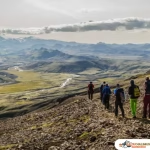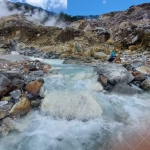
salakhalimunmountain.com – There is a particular quality to the air once you drop below the ridgeline into Kasepuhan territory. The temperature softens, the light turns the color of old brass filtering through kapok and durian canopy, and somewhere below the trail a river you can hear but not yet see keeps its own steady rhythm. This is the threshold into one of Java’s most intact indigenous cultural landscapes — the Kasepuhan communities of the Halimun-Salak region, custodians of a way of life that has shaped this rainforest for generations.
For hikers and nature travelers drawn to Gunung Halimun-Salak National Park, the park’s ecology is usually the headline: the montane forest, the endemic birds, the waterfalls hidden in folds of the hills. But the human story here is just as old and just as woven into the land. Understanding the Kasepuhan is understanding why this forest still stands the way it does.
Who Are the Kasepuhan?
“Kasepuhan” refers to a network of traditional Sundanese communities spread across the highlands of Banten and West Java, including the slopes and valleys that fall within and around the Halimun-Salak landscape. The word itself relates to “sepuh” — elder, or ancestral — and it points to the core of what these communities are: societies organized around customary law (adat), inherited leadership, and a deep, practical relationship with rice, forest, and season.
Each Kasepuhan community is led by a customary elder, often referred to locally as abah or olot, whose role extends well beyond ceremony. The elder is the keeper of agricultural calendars, the arbiter of land use decisions, and the figure who holds the community’s oral history of how forest, farmland, and settlement are meant to fit together. Decisions about which forest is protected, which is cultivated, and which is left to regenerate are not bureaucratic — they are customary, inherited, and taken seriously across generations.
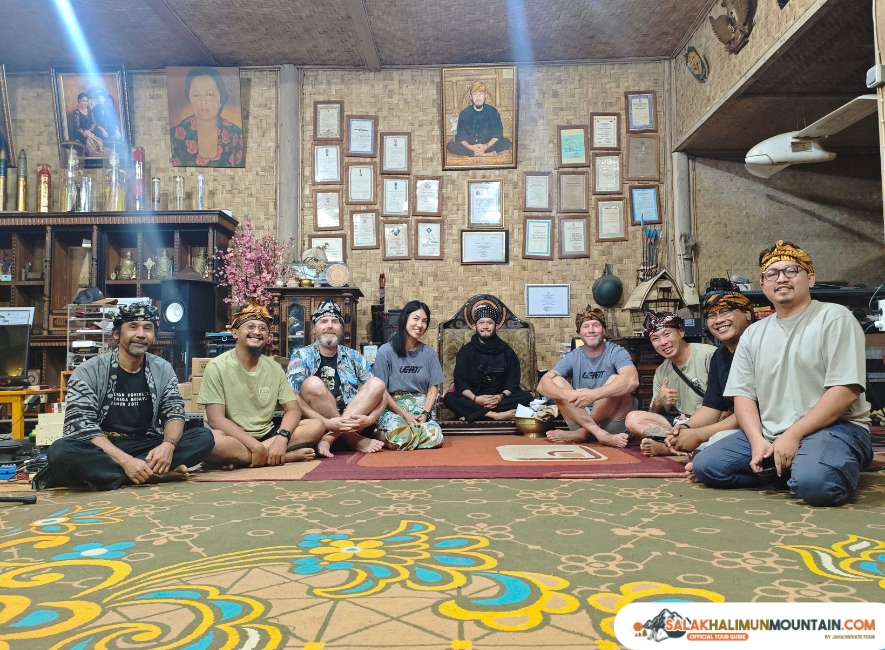
Kasepuhan Gelar Alam, situated within this same Halimun-Salak corridor, is one of these communities — rooted in the same customary rice traditions and forest stewardship practices found throughout the network, while carrying its own local leadership and specific village history.
Rice, Not Just as Food, but as Law
To understand Kasepuhan life, you have to understand rice — not as a commodity, but as the organizing principle of the calendar. Traditional Kasepuhan agriculture centers on rain-fed rice cultivation, often on terraced or sloped fields worked without chemical inputs, following planting and harvest cycles set by customary reckoning rather than the market. This is slower agriculture, tied to lunar and seasonal observation, and it produces a rhythm of communal labor: planting days, weeding days, harvest days, each with its own social weight.
The harvested rice doesn’t simply go to market or straight to the kitchen. It goes into the leuit.
The Leuit: Architecture as Philosophy
Scattered at the edges of Kasepuhan settlements, raised slightly off the ground on wooden posts, are the leuit — traditional rice barns built with steep thatched or wood-shingled roofs designed to shed the region’s heavy rainfall. Their elevated construction keeps stored grain away from moisture and pests, but the leuit is more than clever engineering. It represents a philosophy of collective food security: rice stored here is meant to outlast a single harvest, held in reserve against lean seasons, and in many Kasepuhan communities its use is governed by customary rules about when and why the reserve can be drawn down.
Walking through a Kasepuhan settlement, the leuit are often more numerous than you’d expect for the number of houses — a visible, physical expression of a community’s insurance system, built long before anyone used that word.
Adat: Living Custom, Not Museum Culture
It’s worth being precise here, because it’s easy for outsiders to flatten adat into something folkloric or performative. It isn’t. Adat in Kasepuhan communities is a functioning system of land governance, social obligation, and seasonal ritual that continues to operate today, adapting where it must while holding firm on core principles — particularly around forest protection and rice cultivation.
Rituals tied to the agricultural year remain part of Kasepuhan life, marking key moments such as the start of planting and the close of harvest. The specifics of these observances vary from community to community and are not something to reduce to a tourist itinerary line — they belong to the people who practice them, on their own terms and timing.
How the Forest and the Farmers Coexist
One of the more counterintuitive things a visitor learns here is that the presence of Kasepuhan communities inside and around Halimun-Salak’s protected forest is not a conservation problem — in many respects, it’s part of why the forest has survived. Customary land-use zoning, passed down through generations, has long distinguished between forest to be preserved, forest that can be lightly used, and land for cultivation. This is not identical to the modern national park’s own zoning system, and the relationship between customary authority and state conservation policy has had its complexities over the decades — but the underlying instinct, that some forest is not to be touched, predates the park itself by a very long time.
Getting There: Why Access Has Always Been the Hard Part
For all the interest travelers have in Kasepuhan culture, actually reaching these communities has traditionally been difficult. Many Kasepuhan settlements sit along steep, unpaved routes that wind through national park buffer zones — roads that are hard on standard vehicles, harder still to navigate without local knowledge of which paths are currently passable, and largely inaccessible to anyone relying on public transport or a rented car.
This is part of why most visitors to Halimun-Salak never get past the park’s main trekking gates. The communities are close by on a map and genuinely remote in practice.
A Route Built on Real Relationships, Not a Staged Stop
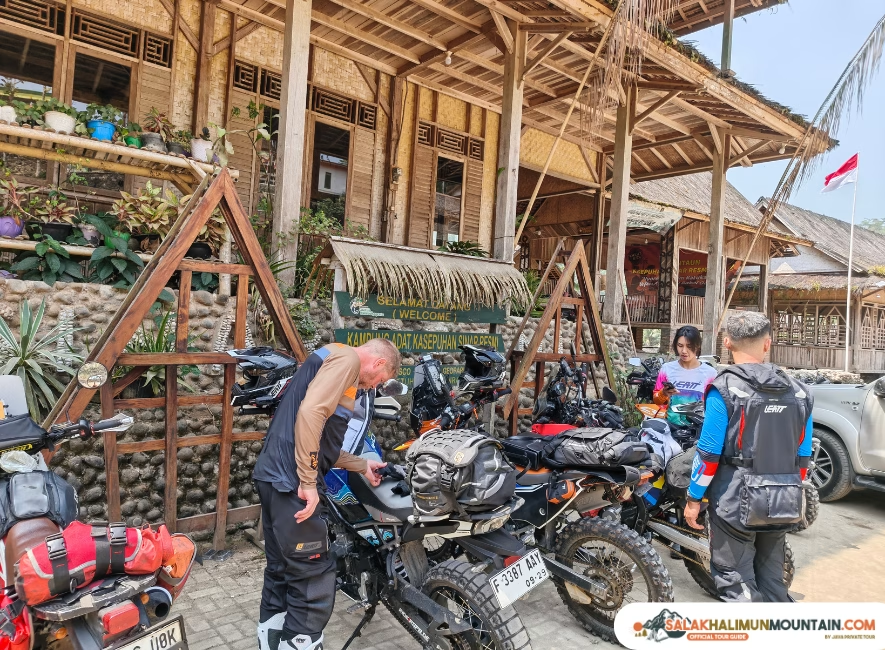
One of the more direct ways this gap has been closed is through JavaRide’s Gelar Alam motorcycle route, part of our network of Java travel platforms, which runs through this exact stretch of the Halimun-Salak corridor. Rather than treating a Kasepuhan village as a photo-op stop bolted onto a generic itinerary, the route is built around an existing, ongoing relationship with Kasepuhan Gelar Alam — meaning riders are moving through the region with someone who knows the elders, understands which parts of daily life are open to respectful observation, and can navigate both the terrain and the customary etiquette involved in visiting a living community rather than a display.
Traveling this way — on a motorcycle, through the buffer zone roads that ordinary transport can’t handle, with a rider who has an actual standing relationship with the community — is a fundamentally different experience from a bus stop with a gift shop. It’s slower, dustier, occasionally uncomfortable, and considerably more honest about what it’s showing you.
Visiting with Respect
If you have the chance to spend time near a Kasepuhan settlement, a few principles go a long way. Ask before photographing people, homes, or ritual spaces. Follow your guide’s lead on where it’s appropriate to walk. Understand that you are a guest in a functioning agricultural and customary system, not a spectator at an exhibit. And resist the urge to treat any single conversation or observation as representative of “Kasepuhan culture” as a whole — this is a network of distinct communities, not one uniform tradition.
Responsible trekking ethics apply just as much to cultural encounters as they do to trail conservation: leave no trace, take only photographs (with permission), and let the pace of the community set the pace of your visit.
Why This Matters for Anyone Exploring Halimun-Salak
Even for travelers whose main interest is the trekking, the waterfalls, or the birdlife of Gunung Halimun-Salak National Park, the presence of the Kasepuhan communities adds a dimension that’s easy to miss from a trail map alone. This forest is not empty wilderness being protected from people — it’s a landscape that has been actively shaped, managed, and in many ways preserved by the people who have lived within it for generations. Understanding that changes how the whole park reads, from the terraced rice fields visible on the approach roads to the unusually intact old-growth stands deeper in the reserve.
So, if you’re ready to explore the wonders of Mount Salak Halimun, head over to our ONLINE BOOKING PAGE and let’s start planning your adventure. Or simply CLICK THIS LINK to chat with us on WhatsApp.
With our team, you’re not just getting a guide; you’re gaining a local friend who will ensure your trip is nothing short of extraordinary.